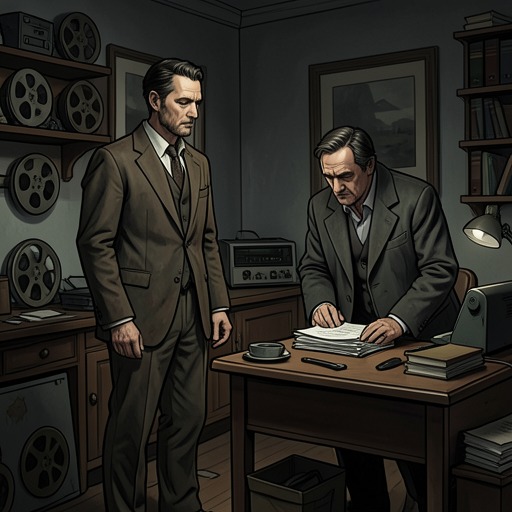
No scene was ever written that couldn’t be improved by the addition of a fistfight
Once Upon a Time in HollywoodThe expression “No scene was ever written that couldn’t be improved by the addition of a fistfight” distills William Witney’s blunt approach to television direction as Rick Dalton remembers it. In Dalton’s telling, a fight is not an ornamental burst of action: it is the device that converts inert dialogue into a playable scene, and a compact emblem of the rougher Western storytelling he recognizes in Lancer.
Witney’s directing principle
Dalton introduces the maxim while discussing Witney’s reputation for staging action. He credits Witney with performing a gag with Yakima Canutt for a serial before John Ford used it, and stresses that Witney had not yet made a feature. The anecdote places the director’s method in practical, fast-moving production rather than abstract theory. Dalton’s formulation is explicit: “Bill Witney works under the assumption that there was no scene ever written that couldn’t be improved by the addition of a fistfight.”
Dalton illustrates the principle with a Riverboat scene opposite Burt Reynolds. The two actors initially deliver their dialogue, but Witney stops them, says they are putting him to sleep, and assigns a punch to each side of the exchange: Reynolds strikes Dalton, Dalton answers in anger, and the scene resumes. After the staged fight, Witney declares, “Cut! That’s it, boys, now we got a scene!” The sequence gives the expression its practical logic: physical action supplies momentum and turns a merely spoken exchange into conflict that can be seen.
The story behind the maxim
The story is also part of Dalton’s effort to explain his accumulated experience in Hollywood. Marvin Schwarz laughs at the account, and the two men share the moment in the smoke-filled office. Schwarz is beginning to warm to Dalton’s hard-earned understanding of film and television work; the anecdote communicates that knowledge through a concrete set story rather than a general claim about craft.
The maxim’s comic bluntness carries a professional point. Witney does not ask the actors to add violence at random: he gives each man an action and a reaction, so the exchange acquires a cause-and-effect structure. Dalton’s telling makes the director’s interruption—the complaint that the scene is dull—the hinge between routine dialogue and an energized performance.
A changing Western grammar
Dalton’s thoughts about Lancer provide a broader context for the expression’s appeal. He considers the series a strong premise with strong characters, but darker and more cynical than Bonanza or The High Chaparral. Murdock Lancer is no reassuring patriarch; Scott Lancer retains the likable quality of a familiar television-Western good guy, while his Eastern-dandy clothing and former Bengal Lancer history distinguish him. Johnny Lancer, by contrast, is written like the shady guest character who would usually appear briefly in another Western, but is instead the lead of the series.
That reversal matters to Dalton’s reading of the genre. He sees Lancer as departing from the established network-Western mold and recognizes Johnny as an unusually dangerous, uncertain central character. The series’ conflict is therefore not reducible to a routine fight inserted to enliven a scene: its premise makes the identity and loyalties of its characters unstable. Johnny’s friendship with Caleb DeCoteau, which he keeps secret from the Lancers, gives that uncertainty a specific dramatic form.
From television convention to reinvention
Sam Wanamaker’s casting choice pushes the same break with convention. Joe Don Baker was another possibility for Caleb, but Wanamaker favored the idea of placing a familiar television cowboy, Dalton, in the heavy’s role. The choice would make Dalton’s established image part of the series’ design: the audience would see a known Western star as the antagonist facing Johnny, rather than simply encounter another unfamiliar villain.
Wanamaker could not reproduce the full violence of contemporary film Westerns on a CBS series airing at 7:30 on Sunday nights. He could, however, pursue their grittier atmosphere through costumes and through the characterization of Johnny Lancer. Against this background, Witney’s fistfight maxim reads as an economical craft rule from an earlier production tradition, while Lancer’s ambition lies in changing what a Western lead and a Western conflict could look like. The expression joins those two ideas: action can rescue a scene, but a change in character and genre expectations can make the conflict itself newly compelling.